

The café had begun to close around her.
Not officially. The lights remained on, the door was still unlocked, and no one had asked her to leave. But the room had changed its posture. Chairs were being turned upside down onto tables at the far end. A cloth moved in slow circles across the counter. The machine released a final violent breath, louder now that most of the voices had gone.
YLSHAA sat beside the window with her coat still on.
Outside, the rain had stopped without clearing the air. Water remained suspended on the glass, breaking the streetlights into pale, unsteady shapes. Every passing figure appeared twice: once on the pavement and once inside the window, crossing her reflection before disappearing.
She had been writing for nearly an hour.
Most of the page contained fragments that would lead nowhere.
A corridor with no doors.
The sound of somebody washing a cup in the next room.
A light left on for a person who had already gone.
She crossed out the last line, then wrote it again lower down.
It remained false.
She turned the page.
There were nights when she could feel a song somewhere nearby, not yet audible but already exerting pressure. On those nights, writing felt less like invention than waiting beside a wall for a sound to pass through it.
This was not one of those nights.
Nothing gathered. Nothing opened.
She wrote because leaving the notebook closed would have made the silence too complete.
At the next table, a woman sat with an untouched drink and a small suitcase beside her chair.
YLSHAA had noticed the suitcase when she entered, then forgotten it. It stood upright between the woman’s feet, one hand resting on its handle even while she looked towards the window. There was nothing unusual in that. The café was close enough to the terminal for travellers to wait there when they had time to waste.
Still, the hand remained on the handle.
YLSHAA looked back at her page.
Without deciding to, she wrote:
Leaving is not the same as disappearing.
The sentence occupied the middle of the paper.
She read it once.
Then again.
It sounded too certain. Not wise, exactly, but arranged in the shape of wisdom. She distrusted sentences that closed too easily around themselves.
Leaving what?
Disappearing from whom?
The distinction might be true, or merely attractive. A phrase could resemble a door while opening onto nothing.
She placed the pen beside the notebook and watched the words as though they belonged to someone sitting opposite her.
For several seconds, she tried to remember the thought that had preceded them.
There had been none.
Or none that she could identify.
The sentence had arrived complete.
Someone stacked two chairs behind her. Their metal legs struck together with a brief, hard sound.
YLSHAA tore the page from the notebook.
She did not do it angrily. She folded it once, then unfolded it. The crease passed through the word same.
The person behind the counter glanced towards her.
“We’re closing.”
YLSHAA nodded.
She slipped the notebook into her bag, put on her gloves, and gathered the few coins beside the empty cup. The torn page remained on the table. She saw it there. She might have taken it.
Instead, she left.
The cold outside was sharper than she expected.
The street had emptied while she was writing. Shopfronts had gone dark, except for a pharmacy light and a narrow restaurant where two people still sat beneath a television they were not watching. Water ran along the gutter in small black currents.
YLSHAA walked without hurrying.
The terminal was only a few streets away. Its roof appeared above the surrounding buildings as a broad horizontal darkness cut by strips of white light. She could have taken another route home, but the terminal stayed open late, and crossing through it shortened the walk.
The automatic doors opened before she reached them.
Inside, the air was overheated and smelled faintly of wet fabric, dust and burnt coffee. Rows of moulded seats faced a wall of glass. Beyond it, several coaches waited beneath fluorescent lights, their engines silent, their windows reflecting the empty platforms.
A recorded announcement dissolved in the ceiling. The words were almost comprehensible.
YLSHAA slowed.
The woman from the café was sitting near the departure boards.
The suitcase stood beside her.
In her hands was the torn page.
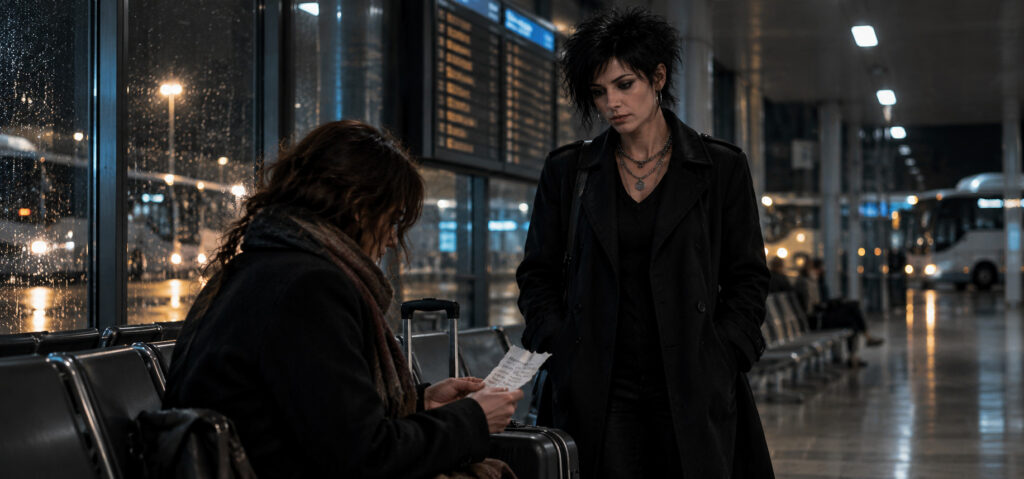
YLSHAA recognised the fold before she recognised her own handwriting.
For a moment she considered continuing towards the opposite doors. The sentence no longer belonged to her in any practical sense. She had abandoned it. The woman had found it. Nothing required explanation.
But the page looked different between another person’s hands.
More consequential.
YLSHAA approached.
The woman looked up before she spoke.
“That’s mine,” YLSHAA said.
The woman glanced at the page.
“You left it.”
“I know.”
“So it wasn’t yours anymore.”
Her voice was neither defensive nor apologetic. She folded the page along the existing crease and held it between two fingers.
YLSHAA remained standing.
“I didn’t mean to leave it for someone.”
“I didn’t think you did.”
“Then why take it?”
The woman looked down at the sentence.
“I thought it was meant for me.”
The brightness of the room made the words appear almost grey.
“It wasn’t meant for anyone,” YLSHAA said.
The woman placed the page on her knee but did not release it.
“That doesn’t mean I didn’t need it.”
An announcement interrupted them. The woman turned towards the departure board. One line had changed. The time beside a destination flickered, disappeared, and returned twenty-five minutes later.
“Delayed,” she said.
YLSHAA looked at the suitcase.
“You’re leaving tonight.”
“Yes.”
“Because of that sentence?”
The woman gave a short, almost soundless laugh.
“No.”
The answer came too quickly to be evasive.
YLSHAA sat two seats away.
For several moments, neither of them spoke. A vending machine vibrated against the wall. Somewhere beyond the glass, a driver opened a luggage compartment and let it fall shut again.
The woman smoothed the torn page against her knee.
“I had already bought the ticket,” she said.
“That doesn’t answer the question.”
“It answers the important part.”
YLSHAA waited.
The woman did not continue.
“Does anyone know you’re leaving?”
The page stopped moving beneath her hand.
“That is a different question.”
“It’s the question I asked.”
The woman looked at her then, not offended, but more attentive.
“Do you always speak to strangers this way?”
“No.”
“Why me?”
“Because you’re holding something I wrote as though it told you what to do.”
“It didn’t tell me what to do.”
“You said it was meant for you.”
“That’s not the same thing.”
The words sat between them.
The woman looked again at the sentence, perhaps noticing the accidental echo.
YLSHAA extended her hand.
“Give it back.”
“No.”
It was the first word the woman had spoken with any force.
YLSHAA lowered her hand.
“You don’t know whether it’s true.”
“I don’t need it to be true.”
“Then what do you need it for?”
The woman leaned back in the seat. Her hand returned to the suitcase handle.
“To make something difficult to deny.”
“What?”
“That I was already going.”
The recorded voice announced another departure. A small group rose together, lifting bags and pulling coats closed. Their footsteps crossed the hall and disappeared through the doors to the platforms.
The woman watched them leave.
YLSHAA said, “Where are you going?”
“Somewhere I can stay for a few nights.”
“That isn’t what I asked.”
“It’s all I’m going to answer.”
There was no fear in the refusal. No invitation either.
YLSHAA studied the departure board without reading it.
She was beginning to understand that the woman had not taken the page in search of instructions. Whatever she had decided had been arranged before the café, before the sentence, perhaps before this night.
Yet the page had become part of the decision now.
Words did that. They entered events late and behaved as though they had caused them.
The woman stood.
“I need air.”
“You’ll miss the coach.”
“It’s delayed.”
She lifted the suitcase.
YLSHAA rose as well.
The woman noticed.
“You don’t have to come.”
“I know.”
Outside the terminal, the cold had deepened.
They walked along the side of the building, where the bright interior lights gave way to a row of closed offices and service doors. The pavement was uneven there. Water had gathered in shallow depressions, and each passing car broke the reflections apart.
The woman pulled the suitcase behind her. One wheel made a faint clicking sound at regular intervals.
They crossed beneath an overpass. Above them, a vehicle moved across the concrete, its weight passing from one side of the darkness to the other.
The woman said, “You still want the page.”
“Yes.”
“You threw it away.”
“I left it.”
“That is often how throwing something away begins.”
YLSHAA looked at her.
The woman’s coat remained closed to the neck. She carried no handbag, only the suitcase. One hand was bare, the other hidden in a pocket.
They passed a laundrette whose windows were filled with revolving circles of pale fabric. No one was inside. The machines continued their work without witnesses.
“How long have you been planning this?” YLSHAA asked.
“I don’t know.”
“You bought the ticket.”
“That part was today.”
“And before today?”
The suitcase clicked behind them.
“I kept waiting for something to happen,” the woman said. “Something large enough to explain why I couldn’t stay.”
“Did it?”
“No.”
She stopped near the dark window of a closed shop.
Inside, mannequins stood without faces beneath emergency lighting.
“Nothing happened,” she said. “That was the problem.”
YLSHAA said nothing.
The phrase struck too close to something she had written in one of her own notebooks, though she could not remember the exact words.
The woman continued walking.
“There was no moment I could point to. No door slammed. No final argument. No one said, ‘You are not allowed to be this person.’”
“What person?”
“I don’t know.”
“That seems important.”
“It probably is.”
They reached a junction. The signal changed, though no cars were approaching. Both women waited.
Across the street, an apartment window was open despite the cold. A curtain moved outward, then fell back inside.
The woman said, “Everyone thinks leaving has to be about what happened. Sometimes it’s about what kept not happening.”
The signal changed again.
They crossed.
YLSHAA was aware of the woman’s words moving through her before she had decided what they meant. She knew that sensation from music: a sound entering the body faster than thought.
But there was no music here.
Only the wet street, the wheel clicking behind them, the terminal light fading at their backs.
“What wasn’t happening?” YLSHAA asked.
“I wasn’t becoming anything.”
“You were living.”
“That isn’t always the same.”
The woman said it without bitterness.
She described her life in pieces after that, but never in order.
A room where she had slept badly for years.
A table kept clear for meals that had become increasingly silent.
A workplace where people used her name all day, until the name itself seemed to belong to them.
A cupboard full of cups given as gifts.
A coat she had worn because someone once said it suited her.
A key on a ring with three others, none of which opened a place she wanted to enter.
She did not describe cruelty. That seemed important to her.
“No one forced me to stay.”
“Then why did you?”
“Because nothing was bad enough.”
A car passed, lifting water against the kerb.
The woman paused until the sound faded.
“You want a reason that would make sense to anyone,” she said. “There isn’t one.”
“Perhaps there are too many.”
“Perhaps.”
They had reached a bus shelter. The panel behind the bench was blank, the old advertisement removed, leaving only scratches and adhesive marks. YLSHAA sat. The woman remained standing for a moment, then placed the suitcase between them and sat on the opposite end.
For the first time, she let go of the handle.
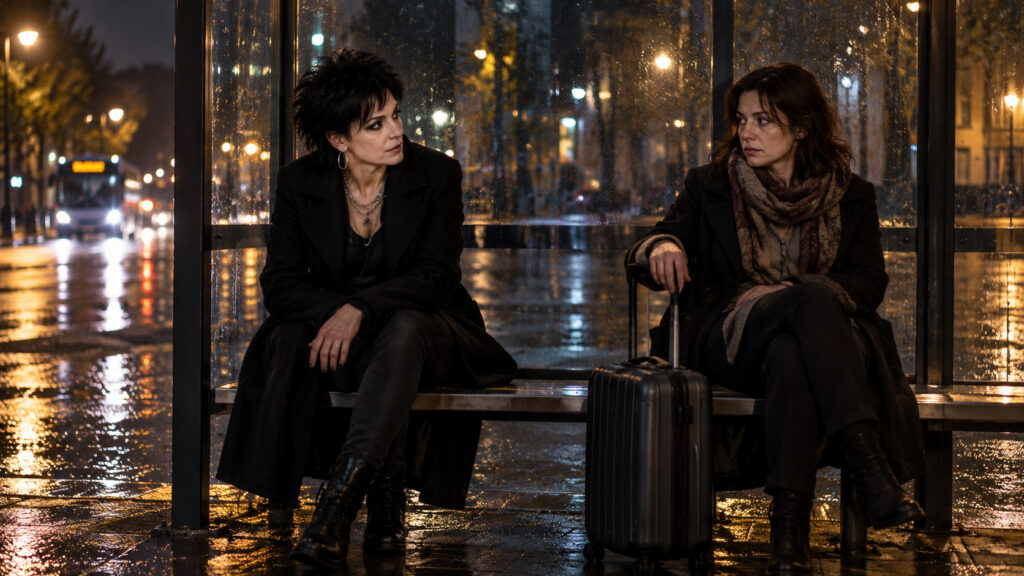
The torn page rested inside her coat pocket now.
“Why did you write it?” she asked.
YLSHAA looked through the glass of the shelter. Their reflections floated over the empty road.
“I don’t know.”
“You must have been thinking about something.”
“I was writing.”
“That isn’t an answer.”
“It’s the only one I have.”
The woman waited.
YLSHAA considered inventing an explanation. She could have said the sentence belonged to a song, though it did not. She could have said she wrote down whatever occurred to her, which was partly true. She could have offered the kind of answer people accepted because it resembled artistic process.
Instead she said, “It arrived before I knew what it meant.”
The woman turned slightly.
“Arrived from where?”
“I don’t know.”
“That sounds convenient.”
“It isn’t.”
The woman looked at the road again.
No bus came.
YLSHAA tried to reconstruct the moment in the café. The notebook. The pen. The woman at the next table. The hand on the suitcase. Had she noticed more than she realised? Had the sentence simply been an inference disguised as revelation?
She had seen a traveller and written about leaving.
There was nothing mysterious in that.
And yet the sentence had not felt observed. It had felt completed elsewhere.
She had already chosen.
The thought entered her with such precision that she stopped breathing for a second.
She had not built it word by word.
There had been no hesitation between she and chosen, no search for tense, no internal correction.
The sentence was simply there.
YLSHAA turned towards the woman.
She had already chosen.
Of course she had. The ticket had been bought before the page existed. The suitcase had been packed before the sentence. The café had only been one room crossed on the way to the terminal.
The woman noticed her looking.
“What?”
“Nothing.”
“You don’t believe that.”
YLSHAA almost replied.
Another thought came.
Ask her what she is taking with her.
This time the words carried a different weight.
Not louder. Lower.
They seemed to stand beneath the thought she was already having, as though they had been waiting for the surface to become quiet enough.
YLSHAA looked away.
She disliked the grammatical force of the sentence.
Ask her.
It was not a suggestion. It did not explain itself.
The woman reached for the suitcase handle.
YLSHAA said, “What did you bring?”
The woman looked down.
“Not much.”
“What?”
“Why?”
“I want to know.”
“That isn’t a reason.”
“No.”
The woman considered her for several seconds, then pulled the suitcase closer.
She unfastened it.
The sound of the zip seemed disproportionately loud in the empty shelter.
Inside were several folded garments, a small washbag, a book with a paper marker halfway through, a notebook, a transparent envelope containing documents, and a photograph turned face down. A key lay by itself in the narrow pocket along the side.
The woman touched none of the objects.
“That’s all?”
“That’s what I decided to take.”
YLSHAA looked at the key.
“What does that open?”
“The place I left.”
“Why keep it?”
“I don’t know.”
“Are you going back?”
“I don’t know that either.”
The woman lifted the key and held it in her palm.
Under the shelter light, it looked ordinary, worn smooth along one edge.
“I thought I’d throw it away before the coach came,” she said.
“Will you?”
“Probably not.”
“Why?”
“Because people like symbolic gestures when they don’t trust practical decisions.”
She returned the key to the pocket.
“If I throw it away, I’ll spend the journey wondering whether I was being brave or theatrical.”
“And if you keep it?”
“I’ll know I still have a choice.”
“You said you wanted the departure to be real.”
“It is real.”
“Even with the key?”
“Especially with the key.”
The woman closed the suitcase but did not fasten it.
A gust of wind moved through the shelter. The blank panel trembled in its frame.
“What about the photograph?” YLSHAA asked.
“No.”
The answer was quiet.
YLSHAA did not ask again.
The woman zipped the suitcase shut.
“When I saw your sentence,” she said, “I thought it meant I could go without turning myself into a ghost.”
“You don’t know what I meant.”
“No.”
“I may not have meant anything.”
“You wrote it.”
“That doesn’t make it true.”
The woman placed both hands on the suitcase.
“You’re very worried about being responsible.”
“I’m worried about a sentence becoming an instruction.”
“It didn’t.”
“You kept it.”
“I kept it because it named the difference.”
“What difference?”
“Between leaving a life and erasing a person.”
YLSHAA felt the words settle into the night around them.
The terminal was visible at the end of the street, a bright rectangular opening in the dark.
She said, “Does anyone know you’re safe?”
The woman did not answer.
“Does anyone know you chose this?”
“No.”
“Then you are disappearing.”
The woman’s expression did not change, but one hand tightened around the handle.
“I’m leaving.”
“From their side, there may be no difference.”
“That isn’t my responsibility.”
“Perhaps not.”
“Then why say it?”
“Because you wanted the sentence to be true.”
The woman stood.
For a moment YLSHAA thought she would walk away alone.
Instead she pulled the suitcase upright and said, “The coach will be here soon.”
They returned towards the terminal.
The conversation seemed finished, but neither of them increased the distance between them.
At the junction, the woman stopped beneath a streetlight and took out her phone.
The screen illuminated her hands.
She unlocked it, then remained still.
YLSHAA waited.
“Who?” the woman asked.
“What?”
“If I tell one person, who?”
“I don’t know your life.”
“No. You don’t.”
The woman looked through a list of names.
Her thumb moved once, then stopped.
“There is someone,” YLSHAA said.
“There is always someone. That doesn’t mean they should be told.”
“Someone you trust.”
“That is not the same as someone who will understand.”
“They don’t have to understand tonight.”
The woman lowered the phone.
A bus passed without stopping. Its interior was empty.
“What would you write?” she asked.
YLSHAA considered the question.
Not an explanation. Explanations invited argument, defence, accusation. Not an apology either. An apology would make the departure sound like a mistake before it had even begun.
“Tell them you’re safe,” she said. “Tell them you need to leave. Tell them when you’ll contact them again.”
“And if I don’t know when?”
“Choose a time you can keep.”
The woman looked at the screen.
Her thumb began to move.
YLSHAA turned away, not wanting to read the message. She watched their reflections in the dark shop window across the street: two figures beneath a light, one holding a phone, the other standing beside an open patch of road.
After a while, the woman said, “Done.”
“Sent?”
“Not yet.”
YLSHAA looked at her.
The woman’s thumb hovered over the screen.
Then she pressed it.
For several seconds, nothing happened.
The phone vibrated almost immediately.
The woman closed her hand around it without looking.
“Now they know,” YLSHAA said.
“They know something.”
“That may be enough for tonight.”
They entered the terminal.
The delay had ended. Passengers were gathering near the gate. A driver stood beside the coach checking tickets while luggage disappeared one case at a time into the compartment below.
The woman joined the end of the line.
YLSHAA stood beside her.
Neither spoke until only two passengers remained ahead of them.
Then the woman took the folded page from her pocket.
She held it out.
“You wanted this.”
YLSHAA accepted it.
The paper was warm from being carried close to the body.
“You don’t need it?” she asked.
“I needed it before I sent the message.”
“And now?”
“Now it’s only a sentence.”
The line moved.
The woman lifted the suitcase handle.
YLSHAA said, “You had already decided.”
“Yes.”
“Before the café.”
“Yes.”
“Before the sentence.”
The woman looked at her.
“You think I found your sentence and decided to leave.”
“I did.”
“I decided first. The sentence only made it harder to lie about it.”
The driver gestured for her ticket.
She showed it, then turned back.
“What is your name?” she asked.
“YLSHAA.”
The woman waited, perhaps expecting something more.
YLSHAA gave her nothing else.
The woman repeated the name once, softly, testing its shape.
Then she boarded.
YLSHAA remained by the gate while the luggage compartment closed and the driver climbed into his seat.
Through the window, the woman was difficult to distinguish among the reflections. For an instant YLSHAA saw her raise the phone and read the message that had arrived. Then the coach lights changed, and her face vanished behind the terminal’s white ceiling.
The engine started.
The vehicle moved away from the platform slowly, carrying its own reflections across the glass until there was nothing left but the empty lane and the lights beyond it.
YLSHAA unfolded the page.
Leaving is not the same as disappearing.
The sentence had survived being torn out, abandoned, found, carried, argued over and returned.
It looked no wiser than before.
But it no longer looked empty.
She walked home.
The city had begun to change colour. The sky above the buildings was no longer black, though dawn had not yet reached the streets. Delivery doors opened. A worker rinsed the pavement outside a bakery. The water spread around YLSHAA’s boots, carrying flour and dust towards the gutter.
She passed the café.
The chairs were stacked behind the glass. The table where the woman had sat was bare.
At home, YLSHAA left her coat on and placed the torn page beside the notebook.
The room was cold.
She switched on one small lamp and opened the notebook to the place where the page had been removed.
The previous sheet bore the pressure marks of the sentence. She could see its shape in reverse, an indentation without ink.
Above it were the fragments she had written earlier.
A corridor with no doors.
A light left on.
Several lines crossed out.
Near the bottom of the page, in smaller writing than the rest, were four words:
She already knew.
YLSHAA leaned closer.
The handwriting was hers.
The angle of the letters, the pressure at the end of knew, the shortened loop in the y—all familiar.
She did not remember writing them.
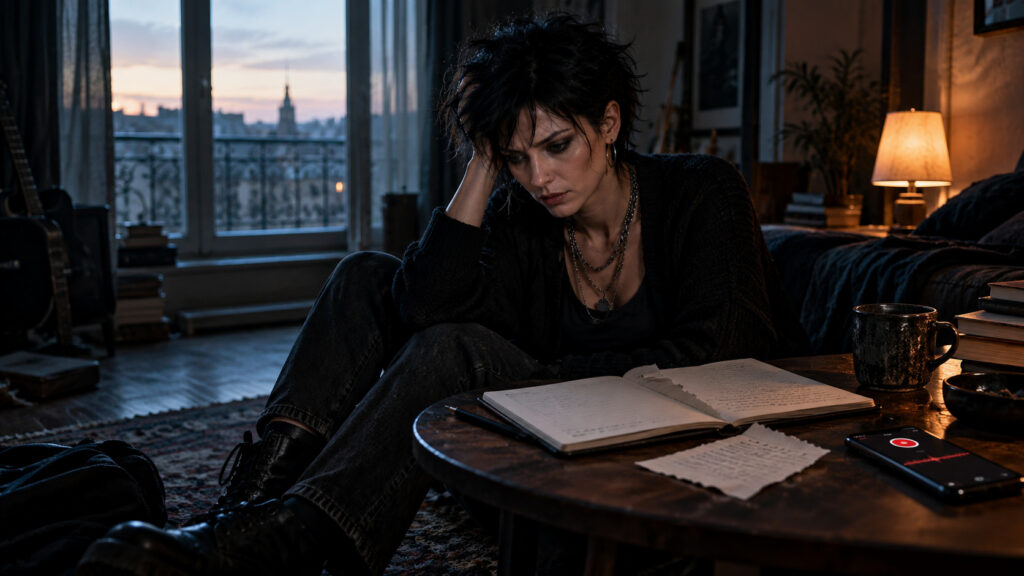
Perhaps she had.
The café had been warm. She had been tired. She often wrote without retaining every line. There was no reason to make the words stranger than they were.
Yet they seemed to stand apart from the page.
Not prophetic. Not supernatural.
Simply earlier than her memory of them.
She sat on the floor beside the table.
For several minutes she listened to the quiet apartment. Pipes moving in the walls. A lift stopping somewhere below. The first traffic beginning at a distance.
She took out her phone and opened the recording function.
The torn page lay in front of her.
She pressed the red circle.
“Leaving is not the same as disappearing.”
Her voice sounded tired, too close to the microphone.
She stopped the recording and listened.
The sentence had become smaller when spoken. Its certainty weakened. It sounded like something written on a card and left for another person to interpret.
She deleted the file.
Then she began again.
This time she did not look directly at the page.
She waited until the room became quiet around the breath in her chest.
The words were still there.
Not above her thoughts.
Below them.
She pressed record.
“Leaving is not the same as disappearing.”
The sentence came more slowly.
Her voice descended on the final word, not dramatically, but far enough that she felt the vibration in a different part of her body. There was a roughness beneath the sound, something usually removed before it reached speech.
She stopped.
The new recording lasted only a few seconds.
YLSHAA listened once.
Then again.
On the page beside her, beneath She already knew, she wrote:
On the second recording, the voice did not sound like an echo. It sounded lower, rougher—already there.
Outside, the first light reached the windows across the street.
On the second recording, the voice did not sound like an echo.