
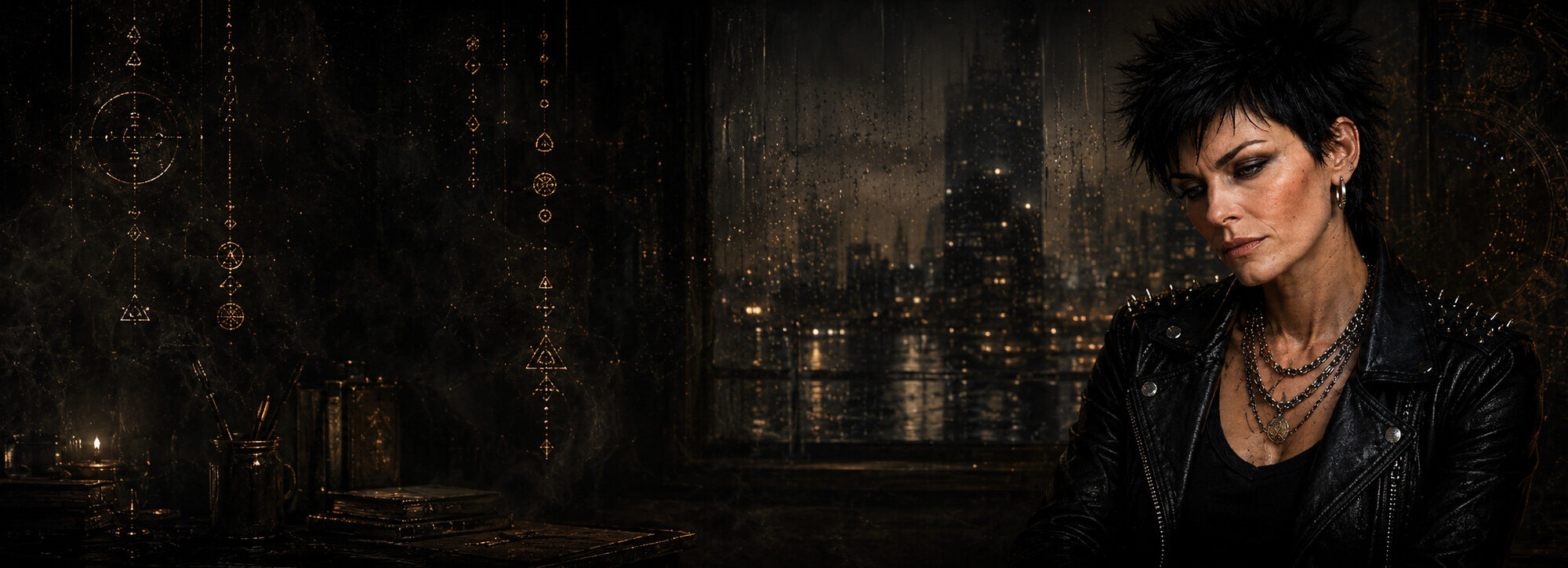
YLSHAA is an artistic persona and singer created and directed by
Yan Lohendra.
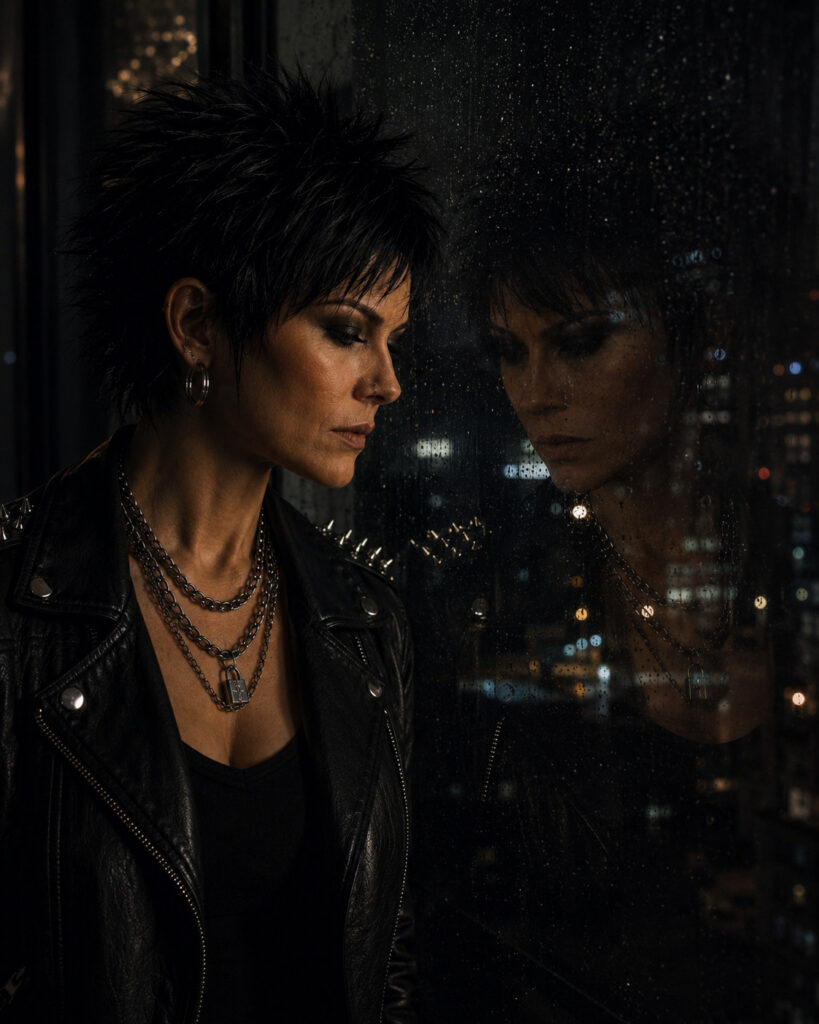
She has a face, a voice, a story and a way of being that unfold through music, images and narrative. Her universe belongs to dark art-rock, but it cannot be reduced to a sombre aesthetic or a stage character. It originates in a particular way of inhabiting the world, perceiving its fractures and searching, behind appearances, for whatever remain real.
The City After Midnight
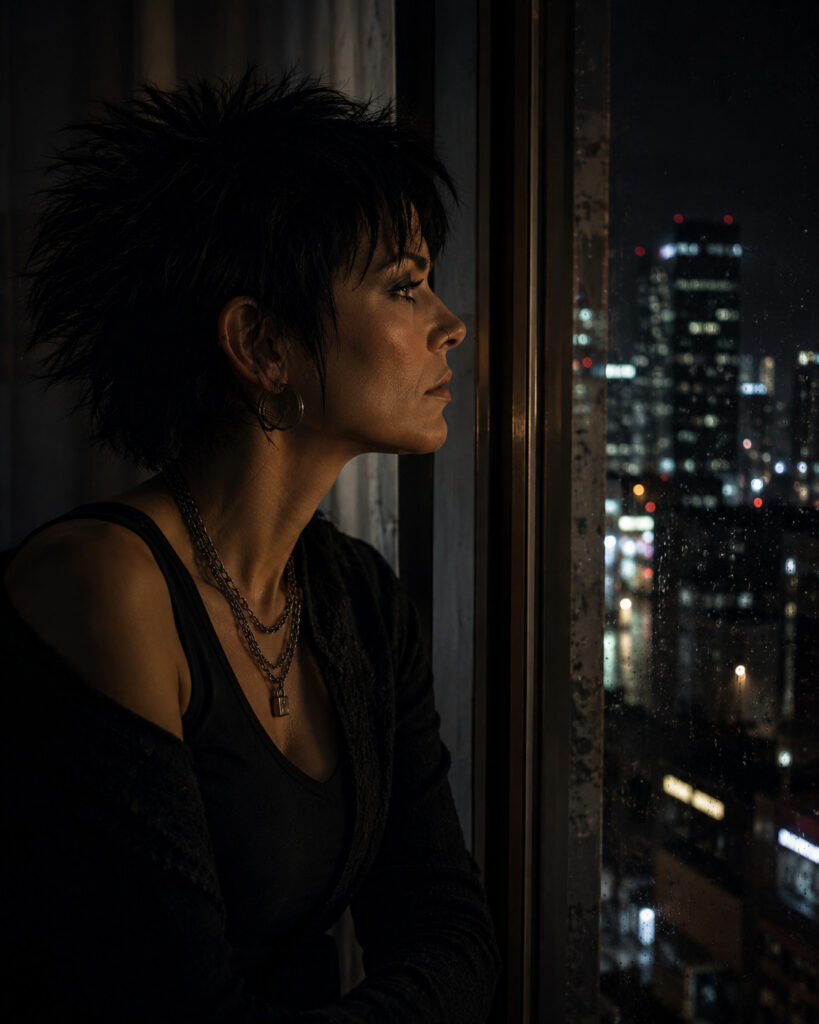
YLSHAA lives in a large city whose name she rarely mentions. She knows it mainly during its late hours: almost empty streets, cafés preparing to close, public transport where a few silent passengers avoid one another’s eyes, and buildings whose windows remain lit long after midnight.
She likes those moments when the city ceases to put itself on display without ever quite falling asleep. During the day, every place seems to have a function and everyone appears to know where they are going. At night, those certainties become less convincing. Streets lose their urgency. Offices become illuminated rooms with nobody inside them. A familiar neighbourhood may suddenly seem like a place she has never visited before.
She walks a great deal, sometimes for several hours, without always having chosen a destination. These walks are not an escape. They allow the noise accumulated during the day to subside and let her observe what remains when conversations, obligations and social roles begin to lose their importance.
She notices lights left burning in empty offices, reflections in shop windows, fragments of sentences overheard in passing, and silhouettes that seem to be waiting for something they themselves would be unable to name.
FROM THE NOTEBOOKSBack late again.
The lift smelled of dust and somebody else’s dinner.
I took the stairs.
Needed the silence.
A Life Becoming Too Small
Her transformation did not begin with a spectacular event.
Nothing collapsed. Nobody arrived to announce that her life had changed. Her former existence simply became increasingly difficult to inhabit. The things that had previously enabled her to carry on—habits, accepted explanations, reasonable objectives—gradually lost their substance. She prefers rare and profound relationships to numerous presences.
She lacks neither confidence nor the ability to mingle with others; she simply finds it difficult to endure exchanges in which everyone recites what they believe they are expected to be.
Conventional conversations, compulsory enthusiasm and the permanent display of the self quickly exhaust her. She dislikes the way people sometimes speak only to confirm that they belong to the same group, hold the same opinions or desire the same things.
This distance can sometimes be mistaken for coldness. Yet YLSHAA is deeply sensitive. She feels intensely what she often chooses not to show. She gives her trust with difficulty, but does not withdraw it easily once it has been granted.
She may appear abrupt when she refuses a lie or an act of complacency, but she takes no pleasure in hurting others. She prefers an honest silence to a consolation she believes to be false.
FROM THE NOTEBOOKSToo many words today.
None of them meant much.
I smiled when I was supposed to.
Exhausting.
She observes more than she speaks. When she does express herself, she dislikes explaining at length what already seems clear to her. She does not deliberately try to create an air of mystery around herself.
If a certain opacity remains, it is because she does not believe that everything must be explained, shared or made immediately accessible.Some experiences are altered by being described too soon. Some feelings disappear the moment they are forced into an acceptable form.
The Notebooks
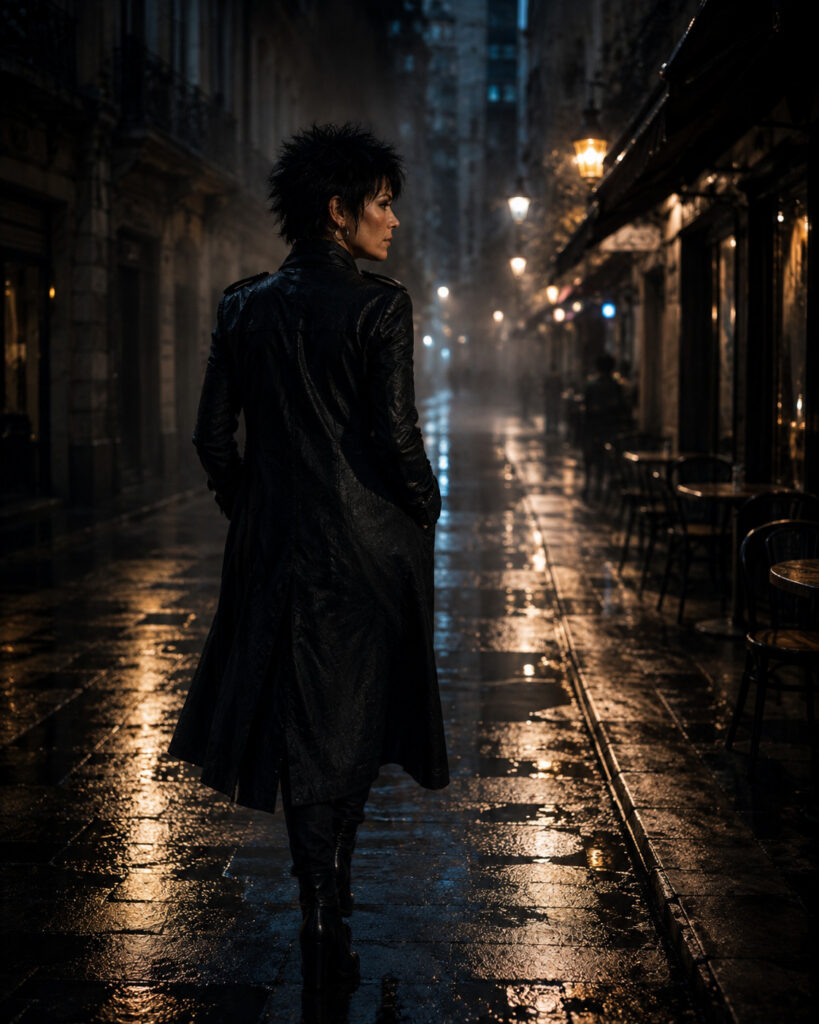
For a long time, YLSHAA has written in notebooks.
She rarely records complete narratives in them. Instead, they contain isolated sentences, descriptions of dreams, images, questions, memories whose context has disappeared, and words she sometimes writes down before understanding their meaning.
Some fragments remain unused for months. Others suddenly become the centre of a song. A sentence written without intention may later reveal that it belonged to something larger.
She does not keep the notebooks in perfect order. Pages are crossed out. Words are repeated. Several ideas may begin and then stop without explanation. Sometimes a single line occupies an entire page.
The window is awake.
No idea what that means.
Keeping it.
For many years, this writing remained a private activity. She did not yet think of herself as a singer and was not trying to construct a body of work.
Music already occupied an important place in her life, but it belonged more to listening, sensation and memory than to a project she wished to show to the public. Certain sounds remained attached to places. Certain voices seemed capable of changing the temperature of a room. A rhythm heard once might continue inside her for hours.
She wrote because writing briefly fixed what would otherwise disappear. She did not imagine that these fragments would one day be sung.
A Life Becoming Too Small
Her transformation did not begin with a spectacular event.
Nothing collapsed. Nobody arrived to announce that her life had changed.
Her former existence simply became increasingly difficult to inhabit.
The things that had previously enabled her to carry on—habits, accepted explanations, reasonable objectives—gradually lost their substance.
Outwardly, she continued to do what was expected of her. She spoke when required, completed ordinary tasks and moved through familiar places. Yet she felt a growing distance from her own actions.
She did not feel estranged from herself. Rather, she had the impression that the life she was leading could no longer contain the person she was becoming.
FROM THE NOTEBOOKSNothing happened.
That was the problem.
Same rooms. Same hours. Same answers.
I couldn’t fit inside them anymore.
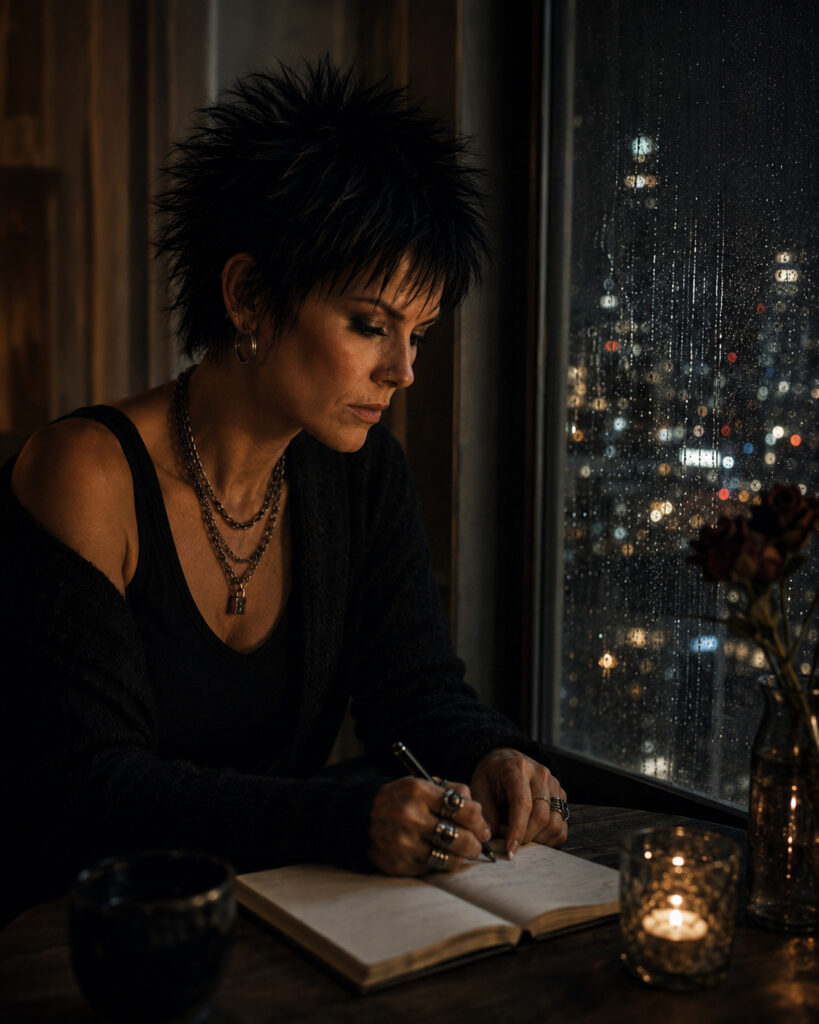
Her nights grew longer. She slept more irregularly and walked more often. Her notebooks filled with shorter, sometimes harsher sentences.
Some seemed to answer a thought she had not yet formulated. Others appeared to know before she did what she was trying to avoid.
She did not believe she was losing herself. On the contrary, she sometimes felt that she was beginning to perceive something that her former life had required her not to notice.
The change frightened her less than the possibility of returning to the person she had been pretending to remain.
FROM THE NOTEBOOKSEnough.
Not anger.
Not courage either.
Just no more room for pretending.
She began to understand that transformation does not always feel like becoming someone new. Sometimes it feels like the slow disappearance of everything that prevented someone from being recognised.
The Voice Below
It was during this period that another voice began to manifest itself.
It was lower than YLSHAA’s usual voice, darker and sometimes rougher, situated somewhere between a whisper and a song.
It did not speak continuously and gave her no orders.
At times, it continued a sentence YLSHAA had begun. At others, it directly expressed what she would have preferred to keep in shadow.
It did not appear as a separate person standing beside her, nor as an intruder occupying her mind.
It seemed instead to emerge when ordinary thought reached its limit.
At times, it continued a sentence YLSHAA had begun. At others, it directly expressed what she would have preferred to keep in shadow. It could appear more lucid, but also more merciless, because it ignored the precautions through which consciousness makes certain truths bearable.
FROM THE NOTEBOOKSA sentence arrived already finished.
Lower than thought.
Mine, I think.
Still mine.
YLSHAA does not regard this voice as a second personality or as a foreign presence. She is not ill and does not live divided between two people.
The voice may be a part of herself that had long remained beyond the reach of language: a form arising from the unconscious, a deeper memory, or the manifestation of something that had never found a place within her conscious life.
It is not another self. It is not a hidden character waiting to replace her. It is a depth within the same person.
FROM THE NOTEBOOKSNot someone else.
Not someone in the room.
A depth.
A pressure.
My voice when it stops trying to be acceptable.
She did not immediately attempt to give it a name. Naming it might have made it too definite, and she did not want to pretend that she understood what it was.
The name Talhiaa came later, when it became necessary to distinguish this particular way in which her own voice descended towards a more obscure region of herself.
FROM THE NOTEBOOKSTalhiaa.
Strange word.
It stayed.
Maybe names are only doors we agree not to close.
Talhiaa has no existence separate from YLSHAA. She shares the same vocal core, but reveals a different depth within it. She does not come from elsewhere: she is the same voice when it reaches a place where YLSHAA does not usually allow herself to appear. Her exact nature remains open. YLSHAA herself does not claim to understand it entirely.
She knows only that Talhiaa must neither be rejected nor left alone in the shadows. Whatever is given no form often ends up acting more violently. What is denied does not disappear. It becomes less visible and therefore more difficult to recognise. Music would later offer a space where this presence could become audible without taking possession of everything else.
Giving Form to What Had No Form
YLSHAA meets Yan Lohendra at a time when her texts, perceptions and vocal fragments already exist, but do not yet form a coherent whole.
She does not approach him with a clearly defined career plan. She mainly possesses notebooks, a few ideas, a voice whose possibilities she does not yet fully understand, and the feeling that a form remains to be discovered.
Yan recognises within these scattered elements something that goes beyond a simple collection of possible songs. He does not try to normalise her voice or erase what makes it unsettling.
He understands that the fragments do not need to be made harmless. They need a structure capable of holding them.
He didn’t ask me to explain everything.
Good.
We listened to the silence after the take.
There was more in it than in the song.

Their work begins with experiments, conversations, texts revised several times and recordings often made late in the day.
Some songs grow from a sequence of chords or a rhythm. Others arise from a single sentence, an image or a sound that initially seems to lead nowhere. A fragment may be abandoned, then return weeks later in a completely different form.
Yan composes, writes, arranges, records and shapes with her a language in which music does not merely accompany words. Textures, silences, ruptures and repetitions become elements of the narrative.
YLSHAA’s clearer voice and Talhiaa’s depth are not treated as two different performers, but as two ways of accessing the same inner life.
FROM THE NOTEBOOKSFirst recording too clean.
Wrong.
Second one cracked in the right place.
Kept that.
This collaboration allows YLSHAA to become publicly what she was already becoming inwardly.
Yan does not cause Talhiaa to appear and does not invent her past. He gives direction and form to what had previously remained scattered. He helps create a space in which YLSHAA can appear without reducing herself to an explanation.
The work does not transform her into someone else. It allows what was already present to become audible.
DUSKWOKEN
From this work, DUSKWOKEN is born.
The album is not a literal diary. Not every song directly recounts an event from YLSHAA’s life. The “I” of a song does not always correspond exactly to the person who sings it.
Nevertheless, the album moves through the questions that accompany her: the fragility of identity, the forces that direct thought without our awareness, the difficulty of reaching reality, responsibility, guilt, the transformation of the human, and the possibility that certain truths can only be approached indirectly.
FROM THE NOTEBOOKSNot a confession.
Not exactly.
More like evidence left in the dark.
In some songs, YLSHAA seems to be speaking to the world. In others, she appears to be addressing herself.
Talhiaa intervenes when ordinary language is no longer sufficient, not in order to contradict YLSHAA systematically, but to reach another region of the same experience.
Sometimes the two voices seem to answer one another. At other moments, the boundary between them becomes almost impossible to locate. The difference does not lie in two separate identities, but in two levels of exposure.
One voice speaks from the surface where meaning can still be organised. The other rises from somewhere beneath that organisation.

YLSHAA did not become a singer out of a desire for fame. The stage, the image and public recognition are not ends in themselves for her.
She sings because music has become the only space vast enough to contain what she perceives without forcing her to simplify it.
She accepts appearing before others because a faceless voice risks remaining an abstraction, and because a song sometimes needs a presence in order to be truly heard. Yet she does not seek to make her entire life visible.
A part of her necessarily remains outside the frame.
FROM THE NOTEBOOKSThey will see the face.
They will hear the voice.
That doesn’t mean they get everything.
Nobody does.
What Remains
YLSHAA continues to walk through the city, to write and to work with Yan Lohendra.
Her life is not limited to the studio. She retains ordinary days, silences, relationships she does not speak about, and places that may never enter a song.
She still observes people from café windows. She still writes down sentences whose meaning may not become clear for months. She still sometimes walks longer than she intended because returning home too quickly would interrupt a thought.
She has not resolved every question opened by DUSKWOKEN.
Talhiaa remains present. On certain nights, she almost seems to disappear. At other times, a sentence or an inflection is enough to recall that she has never gone away.
FROM THE NOTEBOOKSQuiet tonight.
Her or me.
Hard to tell.
No panic.
Just listening.
YLSHAA no longer regards this presence as a problem to be eliminated. She now sees it as a depth with which she must learn to live and create.
Accepting it does not mean surrendering all space to it. It means recognising that a person can never be reduced entirely to the part of themselves they show to the world.
Talhiaa does not make YLSHAA less coherent. She reveals that coherence is not the same as simplicity.
A person may contain impulses, memories and perceptions that do not all speak in the same tone. They may still belong to one life.
FROM THE NOTEBOOKSStill becoming.
Annoying phrase.
True anyway.
YLSHAA’s story is therefore not one of a completed transformation. It is the story of a consciousness continuing to explore its own limits, of a voice discovering what it can contain, and of an artist moving forward without claiming to know in advance what shape the future will take.
YLSHAA pursues this search through music, images and narrative.
Each work reveals a part of her life, but none can ever exhaust it entirely.